Friday, June 14, 2013

Day Ten -- Kortrijk to Oudenaarde

Distance: 28.8
Hills: two large

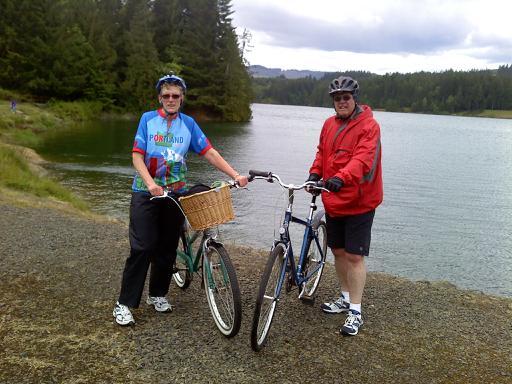
Today we had a relatively flat ride to a town called Oudenaarde.. On the way we passed a couple of antique windmills.   Of course, windmills are far more common in the Netherlands than in Belgium but there  are many in Belgium as well. While they aren't used nowadays, they were used in the past to grind the grain grown in this area.  We took a couple of pics of us and also one with our virtual grand kids. 
 You'll have to look close for Lilly and Davey in Mary Jo's hand.

We were really impressed with Oudenaarde's town hall. It's now operating as a Flemish art museum. Quite a bit fancier than our town hall in Milwaukie, wouldn't you say?
After lunch in Oudenaarde we rode up cobblestone roads for five miles or so, including a couple of fierce hills to a local brewery for a group tour. While the tour itself wasn't particularly riveting, the folks at the brewery were lovely. After the tour we were treated to full glass samples of any of their beers that we wanted, and they also gave each of us a package with two glasses of their Sloeber beer and a beer glass for free! They also sold t-shirts and bike racing shirts with their logos to several of our group. I tried their wheat beer, which is called Mater. It was quite good. William had the Sloeber.  Sloeber is a particularly apt name for a beer for William -- it means naughty boy.

The brewery has been owned and operated by the Roman family since the 16th century. The current CEO is the twelfth generation of his family to run the business. The tasting room, pictured above, is over a century old. 


Monday, June 10, 2013

Day 9 : Ypres


Distance: 27.06 miles
No hills. Totally flat


Note:click on photos to see the whole pic. Sometimes only half shows up on the blog. 


This morning we rode on the boat for a couple of hours before docking and setting out on our bikes. And because we were docked on the north side of the river, not the south, we learned that we were now in Belgium, not France. Because of changes due to the European Union, border crossings are a non-event. There wasn't even a sign, just this little poster. 


We biked a few miles to the Belgian town of Ypres, which was a center of fighting in WWI, and which houses a fine museum about the war.  The city was totally destroyed but has been rebuilt in the same style, so it appears like it was before the war. It is a beautiful town, built in the old Flemish style. 
The textile guild hall, now the home of the Great War Museum. (See our bikes parked out front.)

Here are some facts we learned as we toured the museum:
1) After WWI one in six men in France was killed or wounded.
2) Despite  signs of rising militarism to the north, Belgium did not start military conscription or train a professional army until a year before Germany invaded, so they were totally unprepared for war.
3) Many of the soldiers serving in the Allied forces in WWI came from colonies of European nations, with different (unsuitable) uniforms and weaponry.
4) Soldiers in France, the United Kingdom and Belgium themselves had uniforms unsuitable for the trench warfare of the war -- plumed helmets, spiked helmets, brightly colored jackets, etc. which made them easy targets.
5) 13% of the entire Belgian army died in WWI. 
6) Despite four years of warfare, the battle lines in Belgium moved only a few miles.
7) The countryside around the western section of Belgium and the majority of the buildings in this area were destroyed, but of the war reparations paid by Germany after the war, the vast majority went to France and England. Belgian people paid for nearly all the rebuilding that was done. 
8) Around  thirty WWI bodies are still found every year in this area, along with miscellaneous unexplored ordnance.

What we saw: Military cemeteries with graves of allied victims are located every few miles through the countryside around Ypres. During the four years when battle raged here, about 300,000 soldiers died and most are buried here. Many of the graves are of unidentified soldiers. 
Notice the difference in inscriptions. The one on the left says, "Believed to be buried in this cemetery," while the one on the right says, "Known to be buried in this cemetery."
The grave sites are beautifully tended by local citizens. The decorations above the names represent the units the soldiers served in. 
 This is the Menin gate, leaving Ypres. It has the names of 54,000 officers and men from Canada, Australia, India, South Africa and the United Kingdom who died prior to August 1917 and whose bodies are still missing.  
The red items are red poppy wreaths laid in memory of these missing men. 

Because it is Belgium, Wm. and I bought some chocolates from Leonidas Chocolates and shared them with our virtual grand kids.

On the way back to the barge we ran across a garden open house, so we took a look.  The garden is owned by a sculptor, who had many of these plastic men statues placed strategically around. Here's William doing a life imitates art impression. 
After we returned tithe barge, we motored up the river a little and ended up in Kortrijk.  A barge  from a different bike/barge company pulled up alongside us and roped onto our barge for the night. The folks from their barge walk over our deck to get to shore. Not unusual around here but very interesting to look out the window directly into another barge. 


Sunday, June 9, 2013

Day off in Lille -- Day 8

Lille is the 4th largest city in France and the capital city of the northern region of France. Its  main industries are textiles, mail order companies and shipping. It dates back to the eleventh century.It's the birthplace of Charles de Gaulle. We had a guided tour this morning and were free the remainder of the day. For William and me it was a time to do some laundry, check our email and just wander. Here are a few photos from our day. 
This is the gate of the citadel, which is a huge fortress on the center island of the city, erected under Louis XIV when he took possession of the city from Flanders. It is built in the shape of a five-pointed star and has five layers of defensive walls and moats before the enemy could penetrate the fortress. The design of US pentagon was taken from this design plan.  The citadel is now the headquarters for the French rapid response military force, so it is still in use. It is a Unesco heritage site. 

This is the rear facade of the cathedral. The town ran out of money and couldn't complete the original building so walled it off and used a partially completed church while they waited for money and a peaceful time to finish the construction.  They eventually finished, but this was in modern style, unlike the rest of the cathedral. Construction of this part finished in 1999.  The brown portion is really light beige marble only 28 mm. thick.  With  the sun shining through it, it shines and is meant to recall the burning bush in Exodus. 


We had coffee and pastries at Meert, the oldest confection shop in town and a favorite of kings and presidents. (Charles deGaulle for one) The  middle photo shows chocolates, which are thinner and flatter than Belgian chocolates. Our guide told us that Belgians make their chocolates too thick, so that the dense chocolate walls obscure the taste  of the inner filling. Theirs are flat here rather than round. 

Scenes of stalls at the market, which included a covered food market and  a huge flea market which spread throughout several blocks around the covered market area. 


Day five-- Noyon to Perrone

Distance: 35 miles
Hills: rolling hills, none too difficult
Weather: HOT. We were sunburned despite wearing SPF 30 sunscreen

Nothing fancy today. Rode the long ride through farms and along the Canal du Nord, a shipping waterway in Northern France. Visited a sugar beet factory (boring), a German WWI cemetery and a French WWI cemetery. We are approaching the Somme River, which was one of the very fiercely contested battle areas in WWI.  In a few days we will be in Flanders, where soldiers fought in trenches during the First World War. No pics today. 

Day off in Lille

Lille is the 4th largest city in France and the capital city of the northern region of France. Its  main industries are textiles, mail order companies and shipping. It dates back to the eleventh century.It's the birthplace of Charles de Gaulle. We had a guided tour this morning and were free the remainder of the day. For William and me it was a time to do some laundry, check our email and just wander. Here are a few photos from our day. 

Day Six -- Perrone to Douai


Mileage: 26.6
Hills: Only one steep one.  As every other day there are always many, many long and rolling hills which don't count in my tally. 

Started off this morning by riding the barge from 7 a.m. until 1300, going through 5 locks and a very long tunnel, which took nearly an hour to transverse. All of these were along the Canal du Nord, which is taking us up to the Flemish border.  
Fun road sign -- don't drive car into canal.
Also, don't drive bike into canal.

We rode along through farmland, where the French grow rapeseed, peas, barley, wheat and sugar beets, passing the occasional village.  The weather is very warm, and we were thirsty, so we waylaid a passing ice cream truck and took a break with chocolate bars.  At the end of the ride, the barge wasn't at the pickup spot yet, so we stopped at a pub with shaded outside seating on the shore of a little lake, drank beer and watched the ducks swim until it was time to meet the barge.
Dee die, Cliff, Julie and MaryJo, enjoying their ice cream. Mary Jo's suggestion-- next time we should waylaying a beer truck!

After we boarded, the barge continued up the canal during dinner and early evening and docked at Douai.  It was a very long, but fun day. Tomorrow we have a long bike ride scheduled, which will end in Lille, where we have Sunday off. 

General Bike/Barge Information

This is our second bike/barge trip. The first was three years ago, when we did the North/South Netherlands trip. That trip was on the barge Angeline, which does the great majority of these tours. This trip we are on the Zwaantje, which is somewhat smaller and narrower than the Angeline, in order to fit through the many narrow locks on this trip. Each room has two twin beds, a closet and a tiny restroom with shower. The barges have a communal dining room and a lounge, plus a large deck at the top of the barge, which is a nice place to sit to catch evening breezes. The rails on the deck are collapsible so that the barge can fit under some low bridges. 


Prices for bike/barge are inclusive except for airfare and trips are usually for thirteen days. They furnish your bike, all meals except for one day, when the crew takes off. Beverages provided are coffee, tea and water. You can buy beer, wine, some sodas and some stronger alcoholic beverages from the ship's bar but these are not included in the trip price.  Each morning you will be provided sandwich supplies, fruit and some sort of candy bar or cookie snack, plus a boxed fruit drink and you must pack your lunch, which you then place in the pannier which is on your bike. You also receive a water bottle, which you put in the holder of your bike for drinks along the way.

There are 26 participants on the Angeline and 22 on the Zwaantje, plus two bike guides and a crew of four on the boat. Each evening you are told what to expect on the next day's ride so that you can decide overnight what you want to do. Your options are: 1) Stay on the barge and entertain yourself all day. 2) Short group: generally slower and riding fewer miles, usually around 25. 3) Long group: faster, around 10-12 mph and farther, with a more challenging route, perhaps more hills, about 30-35 miles. Routes are flexible, depending on where the barge stops. One guide rides with each group.
Unloading bikes in the morning
Bikes unloaded and ready to roll. Each has the yellow Bike/Barge panniers on the back, making them instantly recognizable. 

The guide rides in front, with a map, a compass, an odometer, a phone and sometimes a GPS on their bike. The rest of the group rides single-file behind, with one person each day designated as sweep. The sweep and the guide each have an orange pennant on a pole sticking up behind their bike seat so that participants and the guide can see where everybody is along the way. The sweep's job is to always ride at the back and signal the guide if someone is lagging behind or has trouble, such as a flat tire. Guides carry repair gear in their panniers and are experts in fixing what goes wrong.

Groups return to the barge before dinner, usually with some time to look around the city where the barge is moored. After dinner and the  explanation of the next day's route, one of the guides will lead a walking tour of the city for anyone who is interested.

During the rides, groups stop for mid morning coffee break, lunch and for toilet breaks and water bottle refills. If there are interesting sights along the way, the group stops and takes a tour or a look-see.

In the Netherlands, nearly all riding is done on bike paths. Paths are not so frequent in France, so there is a lot of rising on roads, but the guides take care not to ride on busy roads unless necessary. On this France tour, we have spent a lot of time riding through the rolling hills of Frances agricultural heartland and very little time in cities. 

Our tour groups have been quite congenial. Most have a fair amount of biking experience, but some spouses have admittedly come along with the expressed intent of spending very little time biking and a lot of time riding on the barge. The bike/barge company recommends that participants be comfortable riding for at least an hour at a time. I would say that two hours or even more are better. Helmets are not included but are strongly recommended. Although most Dutch people do not wear them, I would not come without one.